
Quasheba
(Powis Gate Project) performance/ceramic panels/short film 2021
Quasheba was commissioned by Aberdeen Art Gallery, supported by The Art Fund 2020 Museum of the Year Award and is now in their collection.
Quasheba was also shown at Cryptic Nights, Centre for Contemporary Arts, Glasgow 2023 and Legacies of Slavery exhibition, University of Aberdeen library 2023
Quasheba was conceived as a piece of guerrilla art, a ceramic panel and performance to mark the (then unmarked) slavery funded Powis Gate. Later Eldin&Love applied for a micro-commission for the project.
An event took place at Powis Gate (two historic towers joined by an arch in the middle of Aberdeen University campus) on Saturday 22nd May 2021. Noon Salah Eldin performed her poem, The Violence of Identity, and Helen Love tied her ceramic panels to the gate in a collaborative effort to draw attention to the use of the profits of slavery to build these Disney folly towers in the heart of Old Aberdeen.
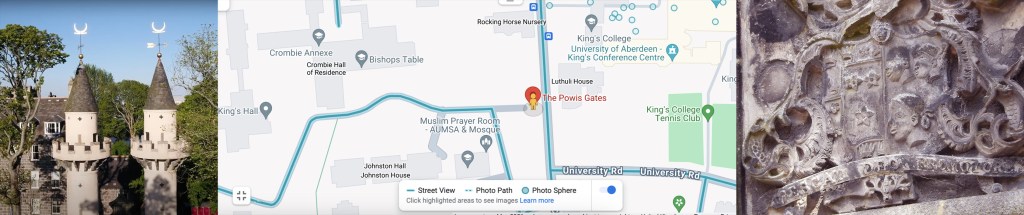
Helen said: ‘I was out walking during lockdown and noticed, for the first time, three headscarved heads in the carved stone crest above the Powis Gate. At that time George Floyd had just been murdered by racist police over in the States and the Black Lives Matter movement was growing. Scottish slavery connections were also to the fore in the news so I was alert to what I though these heads might mean.’
It turned out the heads were not, after all, of enslaved people, but a heraldic pun on the Powis Leslie family’s ancestral name, Moir/Moor, or a boast about beheading Moors in the crusades.
But, despite this false clue, it turned out the gateway was indeed built using gains from plantations and compensation the Powis Leslie family received through the Abolition of Slavery act in 1834. Meanwhile, those freed received nothing for their years, lifetimes, of unpaid labour and depraved treatment as chattel.

Emma Raymond and Neil Curtis, curators and Richard Anderson, historian, of the University of Aberdeen shared their research into the history of the gate. The name, Quasheba, was taken from registries, written between 1817 and 1832, of the enslaved on Castile Fort Pen Estate, Jamaica. We only had her name but desired to bring her to the fore. ‘My part has been to tell the story of the slave, the story of the master never wanted for narrators’ (Frederick Douglass).

THE VIOLENCE OF IDENTITY
Noon’s poem is a personal response to the slavery history of the gate and racism in general.
Noon said: ‘My poem draws on reflections on my journey in migrating from Sudan to the UK, and essays by the Indian economist and philosopher Amartya Sen entitled Identity and violence : the illusion of destiny. I explore how social relations and self-identity are threatened by crude – often uni-dimensional – definitions of identity. I believe that social and personal peace comes from acknowledging the singular complex, contrary, and conflicted human behind masks of identity.’

EVENT
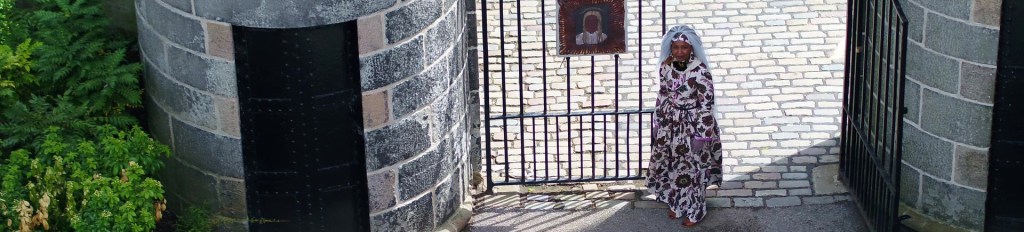
For fear of courting a Covid spread only a handful or so people could be invited to our socially distanced event: supportive university staff, some of our fellow micro-commissioned artists and our camera crew/families came to see Noon’s poetry performance at the gate.
Two paperclay panels were hung back to back on the iron gate with rope. One had the poem embossed on it and one an imagined portrait of Quasheba. The radiating ceramic rays are to draw you through the portal to Quasheba’s world. The rays also reference protest posters and/or Tunnocks teacake wrappers, Scotland’s sweet tooth and links to slavery through sugar.
Over the next few days we observed schoolchildren, students and university security looking at the portrait and reading the poem. Later we hung a QR link to the film and put a review of the Powis Gate and photos of our even on Google maps explaining its dark story to further highlight its slavery history. The panels hung on the gate for five days.

MEMENTOES
Small ceramic mementos were made to give away at our event, just as abolitionist, Josiah Wedgewood, did in the 19th century. Not liking the kneeling posture of the original Wedgewood man in chains, we made our modern version proud, looking straight out. The words on the mementoes: ‘What do you see when you look at me?’ are adapted from the first line of Noon’s poem.

KANDAKE DRESS
Named after the Kandake Kushite warrior queens, Noon’s floor length dress was designed and made by modesty fashion designer, Yousra Elsadig of Boutique de Nana using recycled fabrics from Wales and Sudan. The crescent brooch is normally worn in Sudan by the wedding groom and echoes the crescents atop the Powis Gate turrets.
Nassif Younes, musician, covered The Revolutionaries Kunta Kinte Dub with it’s sci-fi like melody breaking into dub matching the theme of time travel to 19th century Jamaica.
Eldin&Love in conversation about the project here:

 Eldin&Love